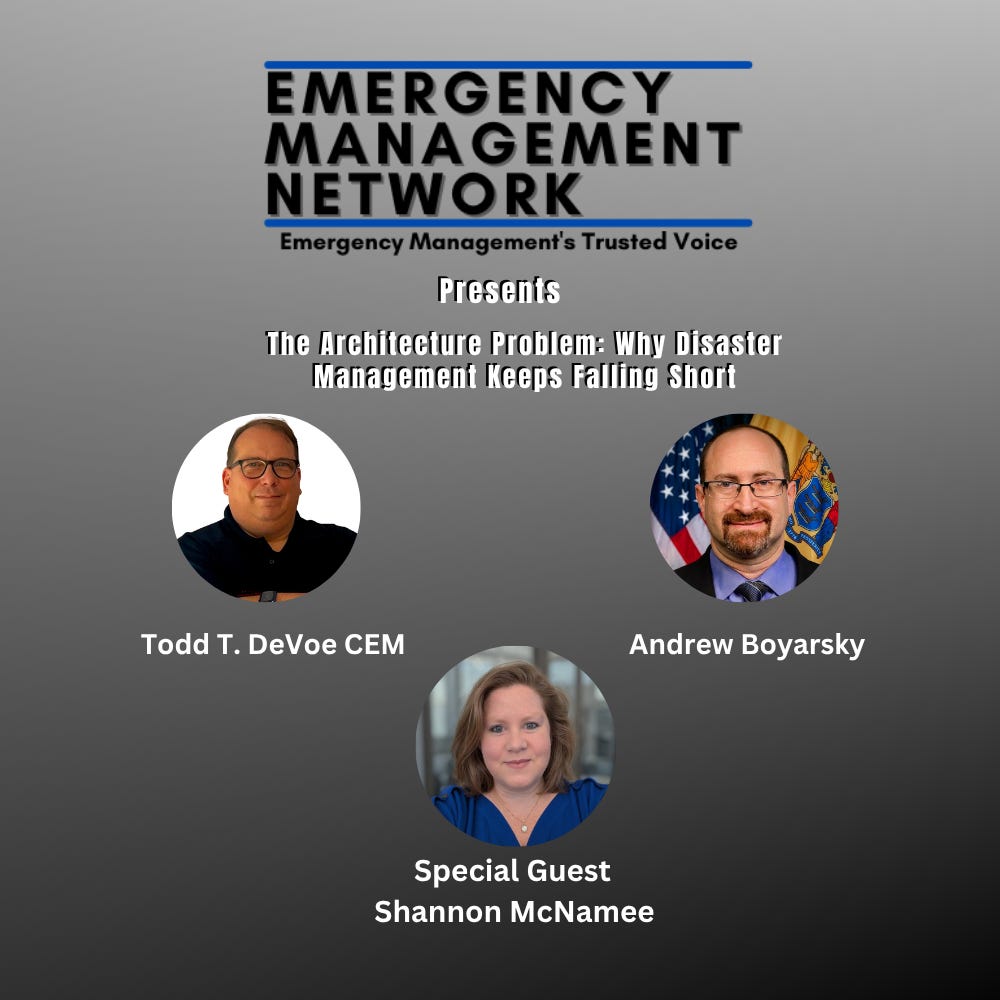
Host: Todd DeVoe
Co-Host: Andrew Boyarsky
Guest: Shannon McNamee, Author of Strategic Disaster Coordination
Episode Overview
Despite decades of investment, disaster response continues to struggle under pressure. The issue is not a lack of effort or experience. It is structural.
In this episode, Todd DeVoe and Andrew Boyarsky sit down with Shannon McNamee, author of Strategic Disaster Coordination, to examine a critical gap in the United States' disaster response. This is not a critique of performance. It is a conversation about system design.
Emergency management in the U.S. is built for incidents that are bounded, short-term, and controllable. Disasters are none of those things. Rather than redesigning the system, we have expanded it—adding layers, complexity, and cost without addressing the underlying mismatch.
This discussion focuses on the operational and strategic implications for emergency managers across all levels of government. The all-hazards framework remains essential, but the scale, duration, and interconnected nature of disasters demand a system built specifically for them.
About the Guest
For more than 15 years, Shannon McNamee has worked at the center of disaster response and coordination—leading operations, building cross-sector partnerships, and designing training that strengthens real-world readiness. Through her roles with FEMA and the American Red Cross, she helped guide large-scale response and recovery efforts while supporting planning, training, and policy development across all levels of government and community partners. As a consultant, she has focused on turning lessons learned into lasting, practical improvements.
She is the author of Strategic Disaster Coordination, a book that challenges conventional thinking in emergency management by arguing that the core issue is not performance, but system design. Drawing on field experience, policy analysis, and research, the book outlines why the current model falls short in disasters—and offers a framework for building a system intentionally designed for them.
Key Themes & Takeaways
Disasters ≠ Emergencies
Emergency systems are built for short, contained incidents. Disasters are prolonged, complex, and disruptive. Treating them the same creates failure points.
It’s a Design Problem
The issue isn’t training or resources. The system is built for control and stabilization, not long-duration, networked crises.
More Layers, Same Problems
We respond to each disaster by adding plans and structures, increasing complexity without improving outcomes.
Old Thinking, New Risks
Cold War-era assumptions still shape policy, but modern disasters are nonlinear, interconnected, and unpredictable.
Why Lessons Repeat
Recurring failures aren’t accidental. They are produced by the system itself.
Misaligned Frameworks
A security-driven model has influenced disaster management, often at the expense of resilience and recovery.
Building What’s Missing
Effective disaster management requires intentional design—integrated, adaptive, and built for how disasters actually unfold.