
How to Cut a Firebreak
When the threat is federal policy changes impacting your group or organization, consider using a protection technique from wildfire response


"Cut a firebreak" refers to creating a space free of flammable materials to stop the spread of a fire, often used in the context of wildfires or prescribed burns. It's a fire management technique to control or extinguish wildfires by removing the fuel that fuels them.
Emergency Management organizations across the country are scrambling to protect against and prevent adverse impacts to their very existence, from changes to federal policies and procedures. This can range from the funding sources they have relied on for years, to staffing support full-cycle. Some organizations are taking a deep dive into their websites, online postings, anywhere a search engine could find evidence of verboten actions or even wording, and making the hard decisions to scrub (i.e., self-censor themselves) that material or to stand their ground and fight. This scrubbing effort may be successful when it’s done in the space between the raging threat and the things (people) you want to protect. The time and space for a firebreak. If you take too long to do this, the threat will consume your organization, attacking it at every angle. Ask Harvard about this.
Let’s be clear – the same issues facing governmental and non-governmental organizations at all levels (national, state/territorial/tribal, local) from a fiscal standpoint, impact the Emergency Management capabilities at those same organizations.
Columbia University is another good case in point: their protection of life safety for their students in an emergency (civil unrest on campus) was not paramount. Allowing buildings to be taken over by protestors is not incident stabilization. And it is certainly not property/asset protection.
If there is no money for Emergency Management, then there is no Emergency Management. Simple economics: There is no free lunch. And this applies to EMN writers, too! Please consider financially supporting this publication. Thank you.
And let’s also be clear, the threat we are talking about is the policy threats against Inclusion, Diversity, Equity, and Accessibility (IDEA) concepts, along with Climate Change and Global Warming ones. Apparently, mentioning Territories and Tribal Nations might also be considered blasphemy, as well.
So, as organizations which may have cursory DEI programs or statements, they may want to consider renaming them in order to avoid the spotlight stopping on them. Colleges and Universities who take any type of federal funding will see strings attached, along these lines. The policy threat is still upon them – they need to surround themselves with a continuous firebreak. Others, like Target, who had much more complete DEI programs are seeing the fiscal pain of not cutting a firebreak, but rather cutting the DEI program. If instead of cutting a firebreak, you decide to burn down three homes and two houses of worship, your townsfolk are going to be pretty darn angry.
There are VOADs across the country which will not be able to cut a firebreak for IDEA or climate (think environment and social governance) or both. Disability Rights groups for example, the Red Cross, where they are responsible for an international set of fundamental principles which specifically align with International Humanitarian Law (even though the United States has not signed on to adhere to them), including Impartiality:
The Movement makes no discrimination as to nationality, race, religious beliefs, class or political opinions. It endeavours to relieve the suffering of individuals, being guided solely by their needs, and to give priority to the most urgent cases of distress.
And you won’t hear complaints from them directly, since they also adhere to a Neutrality principle as well:
In order to continue to enjoy the confidence of all, the Movement may not take sides in hostilities or engage at any time in controversies of a political, racial, religious or ideological nature.
Candidly, it is up to the rest of us to stop the threats against these VOADs, since many will not be able to cut any firebreaks – there’s no space for them to give up. And the threat is upon them now, as well as all of us.
I saw one social media post where a local emergency manager said he would rely on volunteers from NGOs to fill the gaps from lost federal assistance. I am betting that local does not promote volunteering amongst their folks in town, nor do they host fundraisers for these ‘outside’ NGOs, for fear they will lose funding and volunteers for their own emergency services groups. Where does they think the staffing and logistical support will come from, and who will pay for it?
Another post from someone in Michigan noted that they could not count on their NGO to do sheltering - should this be a post on social media or a deeper conversation offering support to that NGO? The writing is on the wall here - local capacity on a whole community/whole of government for the full disaster cycle, is a must have.

Find more of Mike’s more politically unapologetic but still professionally correct articles over at Medium, mostly written for paid subscribers:
30 Days to a Less Powerful Nation - Our twist on the classic “30 Days to a More Powerful Vocabulary,” with what we think are some of the best words to describe the Trump Administration’s actions
When Policy Is the Emergency Management Threat - Emergency Managers across the U.S. are doing their jobs: Planning for Consequence Management
Learning from Our Own History - What started as a vacation ended with a lesson in current events about taxes and tariffs
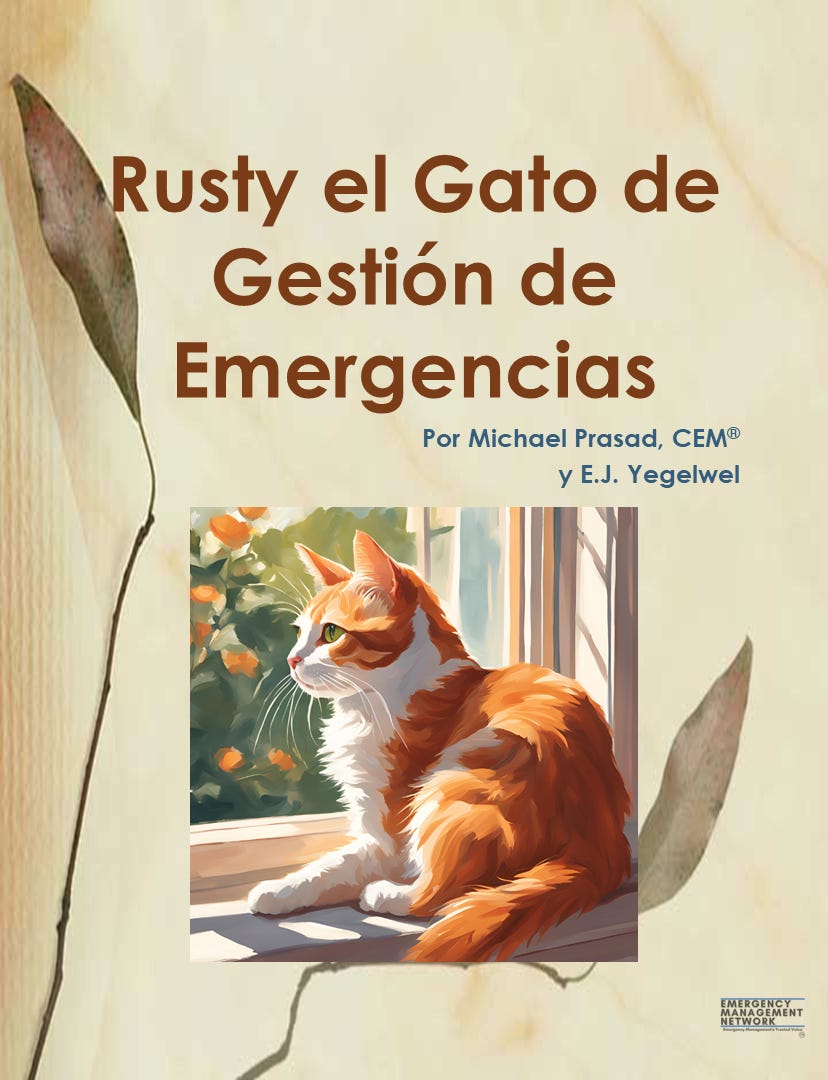
¡El libro Rusty, el Gato de Gestión de Emergencias, ya está disponible en español! Descúbrelo en Amazon / Amazon Kindle en https://www.amazon.com/dp/B0F2JCGT8B/
Over at the CEMIR, we also produce a free blog post once a month (coincidentally at the same time as this one – every 15th or so day of each month). You can subscribe to those here.

And look for a new book coming later this year (July, 2025), which will be free to read online via Pressbooks:

And the Amazon Kindle version of this book is available now for pre-orders. It will be available in print from Amazon as well.

You can find me virtually - and in person! - during 2025 at a number of conferences and trainings, including the IAEM-USA Region 2 conference in Paul Smiths, New York. Click on the badge above for more details. And learn more about my 2025 “tour”, at https://michaelprasad.com/events.
And here’s a good quote to end on, from one of the O.G.’s of quotes, Hippocrates:
“Life is short, art long, opportunity fleeting, experience treacherous, judgment difficult.”