

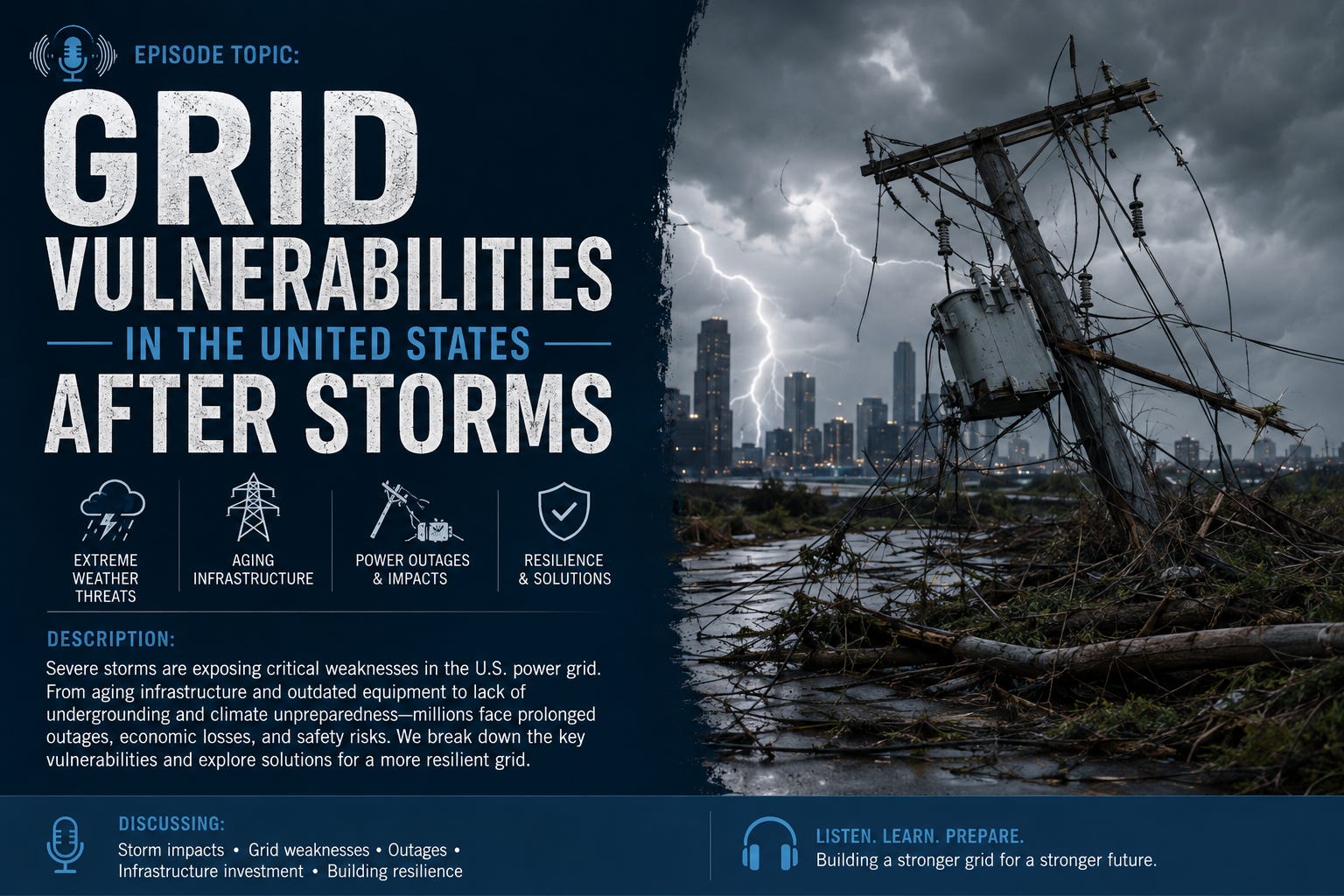
Episode Description
The storm passes. The rain stops. The winds die down. And sometimes, that is when the real emergency begins.
Electricity is the backbone of nearly every system modern communities depend upon. Communications, water and wastewater systems, hospitals, fuel distribution, traffic control, grocery stores, banking, transportation, emergency operations, and even our ability to receive warnings depend in some way on reliable power.
In this episode of the Emergency Management Network Podcast, we examine the vulnerability of the American electrical grid following major storms and extreme weather events. The problem is bigger than a few downed power lines. Hurricanes, tornadoes, derechos, ice storms, flooding, wildfires, and extreme temperatures can damage generation, transmission, substations, and local distribution systems simultaneously.
More importantly, we explore what happens next.
What does a 24-hour outage mean for a community? What changes at 72 hours? What happens when backup generators begin running low on fuel, cellular sites lose power, medically vulnerable residents need assistance, grocery stores cannot refrigerate food, traffic signals stop working, and public safety agencies are operating on emergency power?
For emergency managers, the electrical grid isn’t simply another piece of critical infrastructure. It is the infrastructure upon which much of the rest of our response system depends.
We discuss where the vulnerabilities exist, why severe storms continue to expose them, and what emergency managers should be doing now to prepare for prolonged and cascading power failures.
The question isn’t simply whether the lights will come back on.
The question is: What can your community continue to do until they do?
Show Notes
This episode explores the intersection between extreme weather, electrical-grid reliability, critical infrastructure, and emergency management.
We examine how severe storms can damage transmission and distribution infrastructure and why the consequences extend far beyond homes losing electricity. Major outages can quickly become cascading incidents affecting communications, healthcare, transportation, water systems, fuel supplies, businesses, food distribution, and government operations.
Topics include:
Why severe weather remains one of the greatest threats to electrical reliability
The difference between generation, transmission, and distribution failures
How damaged substations, transmission lines, poles, transformers, and vegetation can complicate restoration
Why undergrounding electrical lines can help in some circumstances but is not a universal solution
The growing importance of microgrids, distributed generation, battery storage, and backup power
Generator dependence and the challenge of maintaining fuel supplies during prolonged outages
Telecommunications and cellular-system vulnerabilities when commercial power fails
The consequences of simultaneous power and communications failures
Impacts on hospitals, skilled nursing facilities, pharmacies, dialysis centers, and medically dependent populations
Water and wastewater system dependencies on electricity
Traffic signals, transportation networks, fuel stations, and supply-chain disruptions
The role of utilities inside the Emergency Operations Center
Identifying critical facilities and prioritizing restoration
Community Lifelines and cascading infrastructure failures
Planning for outages lasting 24, 48, 72 hours—or longer
Why continuity planning must assume that commercial electricity may not be immediately available after a major disaster
The Emergency Management Question
Emergency managers cannot rebuild the nation’s electrical grid, but we can understand our dependencies on it.
Every jurisdiction should be asking:
What stops working when the power goes out?
Then:
What stops working when it stays out for three days?
Those two questions can reveal vulnerabilities that may never appear in a traditional hazard assessment.
Electrical resilience isn’t simply a utility problem. It is a community resilience problem.


